
Marcot, B. G., P. M. Cocker, and D. H. Johnson. Owls in lore and culture. Presented at Owls 2000: the biology, conservation and cultural significance of owls. International conference. Canberra, Australia, 19-23 January 2000.
Note - this is an early version of more extensive book chapter:
Marcot, B. G., and D. H. Johnson. 2003. Owls in mythology and culture. Pp. 88-105 in: J. R. Duncan. "Owls of the World: Their Lives,
Behavior and Survival" Key Porter Books, Ltd., Toronto, Canada. 319 pp.
Abstract
Throughout human history, owls have variously symbolized dread, knowledge, wisdom, death, and religious beliefs in a spirit world. In most Western cultures, views of owls have changed drastically over time. Owls can serve simultaneously as indicators of scarce native habitats and of local cultural and religious beliefs. Understanding historical and current ways in which owls are viewed, and not imposing Western views on other cultures, is an important and necessary context for crafting owl conservation approaches palatable to local peoples.
Introduction
I am a brother to dragons, and a companion to owls. Job 30: 29
Thou makest darkness, and it is night: wherein all the beasts of the forest do creep forth. Psalms 104:20
Long before there were ornithologists and graduate students, keen observers in other tribes and bands roamed the forests and plains. In their search for resources they encountered winged denizens of the night and incorporated such spectral figures into their lore and culture.
The North American Cherokees call them uguuk, the Russians sovah, the Mexicans tecelote, the Ecuadorians huhua or lechusas, and aboriginal peoples of the Kaurna area of Australia winta. For centuries, indeed millennia, owls have played diverse and fascinating roles in a wide array of myths and legends. In this era of rapidly shrinking habitats for many owls of the world, a first step toward garnering concern for their conservation is to better understand of the role of owls in cultural stories and lore. In this paper, we hope to foster an appreciation for the breadth by which owls have been invited into the mythos of human societies. We offer this as a celebration of the diversity of response to owls by humankind the world over. The spectrum of human responses is both remarkable and wonderful. No other bird family has aroused more universal fascination and interest, and better can serve as a basis for conservation. For conservation must proceed from respect for diverse cultures and creeds, as much as for the organisms that share our sphere.
Symbols Old and New
I see a likeness between the old, animist forest, where one could not be sure whether a screech owl's call came from a bird or an Omah[1], and the evolutionary forest, with its unclear distinctions between tree and fungus, flower and fir cone. The tree-fungus relationship is as mysterious in its origins and implications as the owl-Omah one. Both belong to a world that goes deeper than appearances, where a buried interconnectedness of phenomena renders behavior ambiguous, where one cannot walk a straight line. - Wallace 1983:83
Owls have always been part of the root metaphors of how humans relate to the land. One of the earliest human drawings dating back to the early Paleolithic period was of a family of Snowy Owls (Nyctea scandiaca) painted on a cave wall in France (Armstrong 1958). Rock paintings or petroglyphs of owls have been found in other disparate locations including the Victoria River region of northern Australia (Flood 1997) and the lower Columbia River area of Washington state, USA (Keyser et al. 1998). Owls played roles in the ancient Mayan cultures of Mesoamerica. A carved bas-relief of the ancient Mayan Ruler 3 of Dos Pilas, in what is now Guatemala, following the death of Ruler 2 in 726 C.E., is shown adorned with a screech owl, apparently a symbol of ruling power or the resurrection of government.
Owls also are very much a part of modern culture, in the sky as well as on the land. In the constellation Ursa Major, at a most dim magnitude of 11.20, is an irregular planetary nebula designated by astronomers as the Owl Nebula (more formally called M97 or NGC3587). In a more terrestrial venue, a query of the U.S. Geological Survey database on place names revealed 576 features in the United States in some way named "owl," such as Owlshead Canyon, Owl Mine, Owl Creek, and Owl Hollow. Records of the Canadian Permanent Committee on Geographical Names lists 88 current and 17 additional historic places in some way named "owl." Doubtless, many other countries have similar designations.
Etymologically, the word "owl" goes back to the Middle English word "oule," which may derive from the Old English "ille," which is cognate with the Low German "ule," in turn going back to the German "eule." The ultimate root of the modern word "owl" was presumed by Lockwood (1993:112) to be a proto-Germanic word "uwwalo" or possibly "uwwilo."
Another derivation of "owl" is the Icelandic "ugla," which is cognate with "uggligr," which gave rise to the Scandinavian "ugly," which led to the Middle English "ugly" and the Modern English word "ugly." The Icelandic "uggligr" does not mean "ugly" in modern connotations (that is, unpleasant to behold), but rather it means "fearful or dreadful." This is precisely the connotation of owl symbols and totems in many myths and legends. Thus, the very names that we use often speak of a deep history of traditional viewpoints and cultural perspectives.
Further, in Hindi, owl is "ul" (similar to the German "eule" or Low German "ule") or "ulu" if referring to one of the large owls (the Hindi or Urdu term for smaller owls is "coscoot"). The ancient Roman "bubo," the ancient Greek "buas," the modern Hindi "ulu," and the modern Hebrew "o-ah" (Holmgren 1988) are obvious onomatopoeias, as is the modern Nepali "huhu."
An awareness and understanding of the deep, complex perceptions of owls in the past may help support efforts to protect those species today. For example, the ancient cultural importance of owls in Europe helps modern conservationists there. The same is true in America. The blend of traditions carried to the U.S. by white immigrants and black slaves from West Africa (Ingersoll 1958) means that North American owl species have a strong cultural profile that may aid conservation measures. Ingersoll (1958) traced the bird beliefs amongst African-American slave and ex-slave communities. Such beliefs seeped into the dominant European-American culture just in the way that African rhythms were given to the world through blues and jazz music of black North America. Thus, current U.S. folklore about owls is an eclectic blend of European and African traditions, and Native American and Asian as well.
This can be extended to an environmental principle for the West (meaning all areas occupied by those of European descent, and also by mixed-race societies such as South Africa, where a highly developed conservation tradition exists.). Any animal or flower with a strong cultural profile, no matter how negative that cultural perception may once have been (such as with bats, wolves, sharks, and owls) is at a major advantage, for conservation, over an animal with no cultural profile whatsoever (such some rodents and sparrows). The advantage is that they are rooted and recognized in the social consciousness. In the case of owls, the deep fears and anxieties they generated and the prophetic status they once held (and still hold) present environmentalists with a handle with which to engage the interest and sympathies of a wider audience. But the critical element in these situations is the fact that most Western cultures no longer perceive owls as omens of evil, or retain only the dimmest vestiges of these old beliefs.
A good analogy would be our celebration of witches and the like at Halloween. We can enjoy the witches' Sabbath today precisely because we no longer believe in demonic power or demonic possession. It's been culturally degraded to the status of a parody. In a sense we mock our former frailties when we dress up as witches and ghouls. But we could never have done that without being detached from the intrinsic and original meaning of the event. In the 17th century, witches and Halloween were literally deadly serious. Now they're entertainment.
However for some or even many Africans, Native North Americans, Asians, and South Americans, these perceptions of owls are living traditions with deep and powerful roots. For example, in Africa, owls are still genuinely believed to be evil. Heimo Mikkola's surveys of attitudes towards owls in Malawi revealed that owls were regarded as bad birds by a very high percentage (> 80 percent) of the people surveyed (Enriquez and Mikkola 1997, MIkkola 1997a,b). One of us (MC) found in West Africa that most people do not like owls and regard them as evil. The standard pigeon English name for owl in West Africa is "witchbird" (Cocker 2000). Rather than garnering support for endangered species such as the Congo Bay Owl (Phodilus prigoginei), the ancient African mythic traditions relating to owls may present a barrier to their conservation. A classic parallel case is the Aye-aye (Daubentonia madagascariensis) of Madagascar where the beast, down to a last few dozen, has been ruthlessly persecuted because of its cultural profile as a witch-creature. The challenge for conservationists is to turn the barrier to an advantage by understanding the cultural moors and helping to craft conservation actions taking these into account.
Conservationists should understand the role a bird like an owl may play in some societies. Conservation policies for a Red Data species, such as the Congo Bay Owl, should not be formulated without understanding local attitudes and any uses of that particular species. Conservationists too often inculcate their own positive view of the animal in question, but fail to change local cultural attitudes, that is, to replace deep fear with admiration and respect. The environmental community cannot tackle owl conservation without understanding the cultural profiles which most owl species have had foist upon them, some positive, and many negative.
Markers of Gods, Knowledge, Wisdom, and Fertility
Many children have grown up with nursery stories of wise old owls. From the ancient Greek legends to the wise owls in Wini the Pooh and The Owl and The Pussycat, we have all seen images in folk tales of owls as the quintessential bearers of knowledge and sagacity.
From ancient Athens, the silver four-drachma coin bore the image of the owl on the obverse side as a symbol of the city's patron, Athene Pronoia, the Greek goddess of wisdom who, in an earlier incarnation, was goddess of darkness. The owl -- whose modern scientific name Athene carries this heritage -- came to represent wisdom from its association with the dark (Saunders 1995). The owl was also the guardian of the Acropolis (Holmgren 1988), and the Roman statesman Pliny the Elder wrote that owls foretell only evil and are to be dreaded more than all other birds (Rackham 1997, as recounted in Martin 1996).
In many other cultures, owls represent wisdom and knowledge because their nocturnal vigilance is associated with that of the studious scholar or wise elder (Saunders 1995). According to one Christian tradition, owls represent the wisdom of Christ, which appeared amid the darkness of the unconverted (Saunders 1995). To early Christian Gnostics, the owl is associated with Lilith, the first wife of Adam who refused his advances and control. The owl had a place as a symbol in the King Arthurian legends since the sorcerer Merlin was always depicted with an owl on his shoulder. In Japan, owl pictures and figurines have been placed in homes to ward off famine or epidemics (Martin 1996).
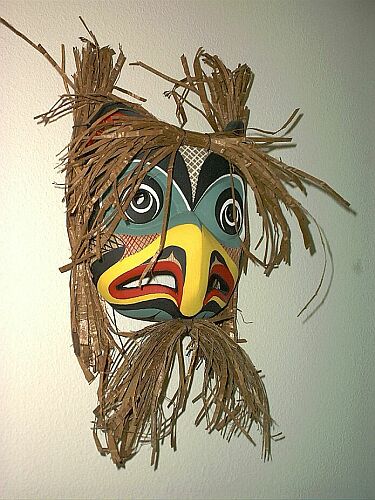
Some Native American cultures link owls with supernatural knowledge and divination. In the Menominee myth of The Origin of Night and Day, Wapus (rabbit) encounters Totoba (the saw-whet owl, Aegolious acadicus) and the two battle for daylight (wabon) and darkness (unitipaqkot) by repeating those words. Totoba errs and repeats "wabon" and daylight wins, but Wapus permits that night should also have a chance for the benefit of the conquered, and thus day and night were born. The Pawnees view the owl as a symbol of protection; the Ojibwa, a symbol of evil and death, as well as a symbol of very high status of spiritual leaders of their religion; and the Pueblo, associated with Skeleton Man, the god of death and spirit of fertility. On a warm afternoon in August 1985, one of the authors (DHJ) observed Ojibwa peoples at a weekend cultural celebration in Duluth, Minnesota using dried wings of Great Horned Owls (Bubo virginianas) as hand-held fans to cool themselves after participating in native dances.
In his book on "Mother Earth Spirituality," McGaa (1990) described the four directions of the Sacred Hoop (the four quarters with the power of earth and sky and all related life) of Native Americans. In this description, the Snowy Owl represents the North and the north wind. The traditional Oglala Sioux Indians (from central North America) admired the Snowy Owl, and warriors who had excelled in combat were allowed to wear a cap of owl feathers to signify their bravery. An old-time society of the Sioux was called The Owl Lodge. This society believed that nature forces would favor those who wore owl feathers and, as a result, their vision would become increased. The owl is a good example of a creature that possesses special powers not found in other animals (McGaa 1990).
Some Native American nations in the U.S. have strong taboos against owls. For example, the Apaches view the owl as the most feared of all creatures (Opler 1965). In 1997, a spokesperson for the Apache told one of us (PMC) about the deep taboo against owls. Historically, Apaches shared the widespread Athabascan fears of owls as the embodied spirit of Apache dead. John Bourke, in his "Apache Campaign in the Sierra Madre," related a famous story of how Apache scouts tracking Geronimo became terrified when one of the U.S. soldiers found and brought along a Great Horned Owl. The scouts told Bourke that it was a bird of ill omen and that they could not hope to capture the Chiricahua renegades if they took the bird with them. The soldier had to leave the owl behind (Bourke 1958).
In another example, the consortium of Yakama tribes in Washington State in the U.S. use the owl as a powerful totem. Such taboos or totems often guide where and how forests and natural resources are used and managed, even to this day and even with the proliferation of "scientific" forestry on Native American lands.
The Blakiston's Fish Owl (Ketupa blakistoni) was called "Kotan Kor Kamuv" (God of the Village) by the Ainu, the native peoples of Hokkaido, Japan. The traditional Ainu people were hunter-gatherers and believed that all animals were divine; most admired were bear and the fish owl. The owls were held in particular esteem and, like the people, were associated with fish (salmonids) and lived in many of the same riverside locations. The Fish Owl Ceremony, which returned the spirit of fish owls to the god's world, was conducted until the 1930's (T. Tekenaka, pers. comm.).
Owls have played various roles in Russian traditions (M. Sova, pers. comm.; Dementev et al. 1951). For example, in Slavonic cultures, owls were believed to announce deaths and disasters. Russians and Ukrainians sometimes call an unfriendly person a "sych," which is also the Russian common name of the Little Owl (Domovoy Sych; Athene noctua). Traditionally, little owls have been disliked and feared by people believing that these birds announce deaths. However, Russian common names of other owls, such as the Scops Owl (Otus scops) -- Splyushka, resembling its call, or Zorka, meaning dawn --do not carry this negative connotation. In old Armenian tales, owls were associated with the devil. In Central Asia [2], feathers of the Northern Eagle Owl (Bubo bubo), particularly from its breast and belly, were valued as precious amulets protecting children and livestock from evil spirits. Talons of the Northern Eagle Owl were said to ward off diseases and cure infertility in women.
[1] - In their stories, the Klamath Mountain Indians of northwestern California, USA, referred to "Bigfoot", an elusive bipedal hominid supposedly inhabiting the deep forests, as Omah.
[2] - In Russian literature, Central Asia is the region to the east of the Caspian Sea including Turkmenistan, Uzbekistan, Tajikistan, and Kyrgyzstan.


