
Owl Skeleton
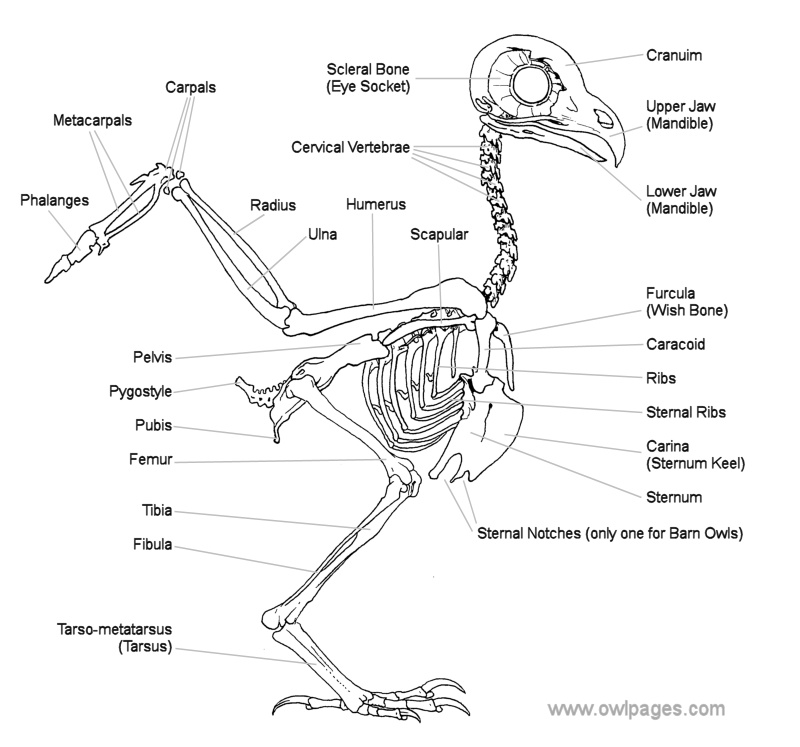
Skeleton of a typical Owl, in this case, a Tawny Owl
A more detailed version of this diagram may be found in the book "Owls: A Guide to the Owls of the World" by König, Weick and Becking.
An Owl's skeleton is typical for birds. Designed for both walking and flying, it is very light and strong. In owls, the skeleton makes up about 7-9% of its total body weight. Many of the bones which would be separated in mammals are fused together in birds, making them strong to support their weight on the ground. In addition, some of the larger bones are hollow, with bony internal bracing. This helps reduce overall weight.
Several Owl species have obviously asymmetrical skulls, which is an adaptation for directional hearing.
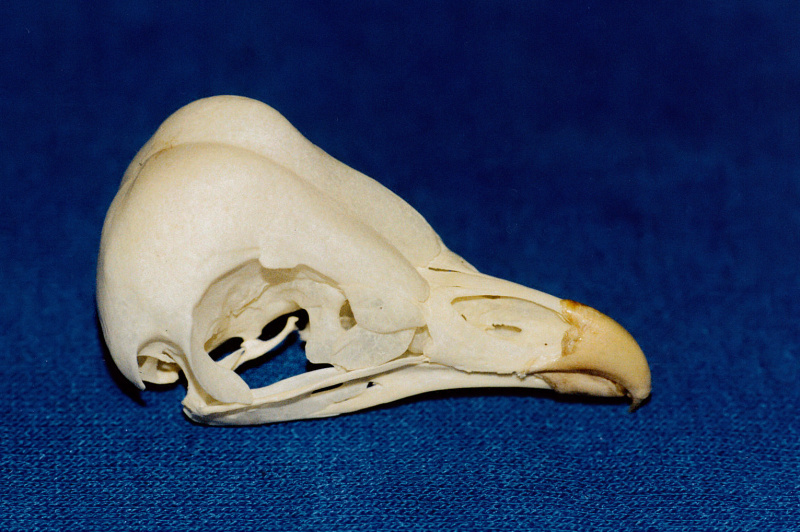
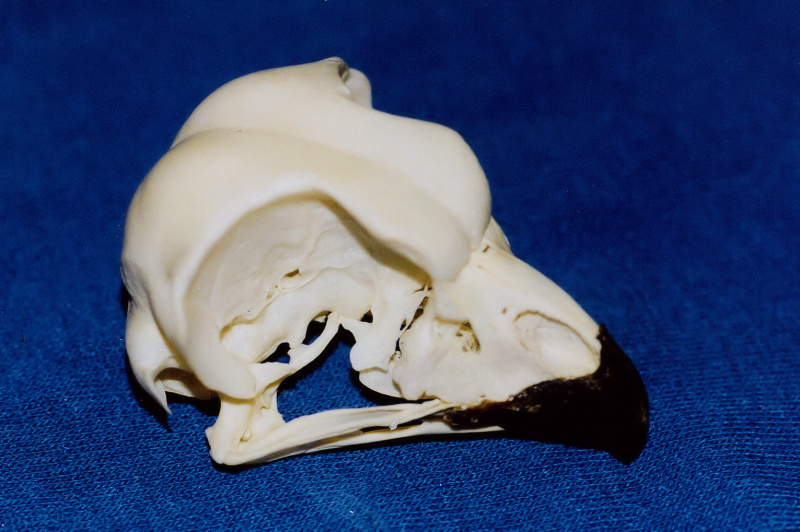
Owls' head turning ability
An owl can turn its head up to 270 degrees left or right from the forward facing position.
An owl cannot turn it's head full circle from a forward facing position as is the common belief. There are several adaptations that allow this:
1) An owl's neck has 14 vertebrae, which is twice as many as humans.
2) Owls have only one occipital articulation with the cervical vertebrae. (There is only one bone situated on top of the backbone.)
Humans have two articulations. This allows the owl to pivot on the vertebrae column much like your body can pivot on one foot.
Their muscle structure is arranged in a manner that allows this movement as well.
3) Owls have a special arrangement of the jugular veins with associated bypass connector blood vessels, to ensure that blood supply (and return)
are not impeded as the neck is rotated.
Other bones
The large flat breastbone, or Sternum, supports the large and powerful flight muscles. It also protects the heart, lungs and other internal organs. In the Tytonidae family of owls, the Carina, or Sternum Keel is broad, becoming narrower towards the abdomen, and the lower edge of the sternum has only small notches on each side. In the family Strigidae, the carina is narrow at its upper part, and becomes broader towards the belly, while the lower edge of the sternum has two deep notches on each side.
The wing bones are relatively long in owls, and the associated wing surface area is broad, producing a low wing loading. This allows for easy take-offs, and effortless flight, even when carrying prey.
The foot bones, or tarso-metatarsi, are relatively short and stout in owls, most likely to aid in the efficient killing and carrying of prey.


