
Owl Talons
Many owl species have feathered feet to protect them from cold weather. The feathers may also serve to sense contact with prey, and to protect against prey that might bite when seized.
An owl's foot has four toes. When in flight, and sometimes when perching, 3 of these toes face forward, and one backwards. When perched, or clutching prey, the outer front toe on each foot swivels to face the rear. It is able to do this because of a unique flexible joint.
Owl's talons are very powerful, as they are used to capture prey. The bony structures in an owl's feet are shorter and stronger than the equivalent bones in other birds. This is in order to withstand the force of an impact with prey.
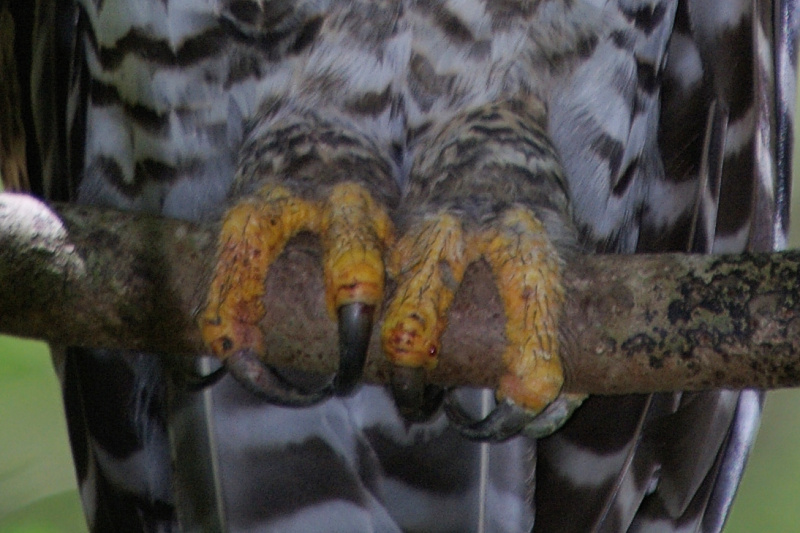
When attacking prey, the talons are spread out wide to increase the chance of a successful strike.
The actual length, thickness and colour of the talons varies greatly with owl species, but all have very sharp claws. Colour may vary from near-black to pale grey or ivory.
The underside of an owl's foot is covered with a rough, knobby surface that helps grip prey or a perch. Barn Owls have a serration on the underside of their middle toe which may help grip prey and also aids grooming. This is called a "Pectinate Claw".
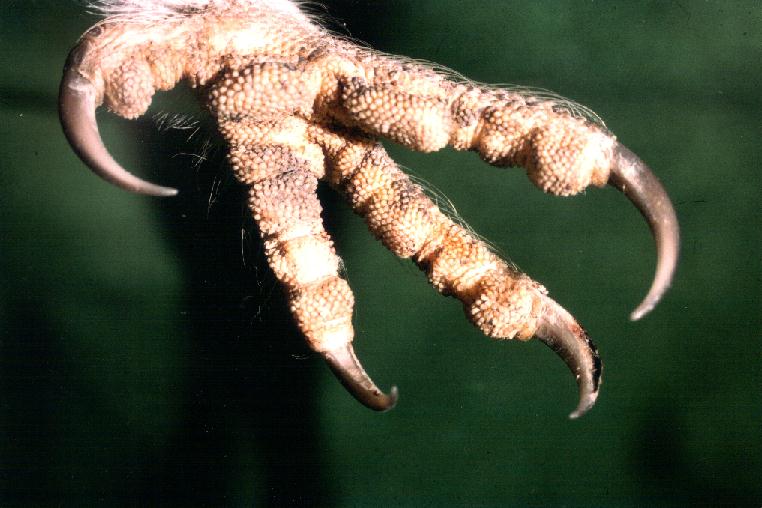
As with other birds of prey, owls have the locking, ratchet-like mechanism in their foot which keeps the toes locked around a perch or prey without the need for the muscles to remain contracted.
In some owl species, it is thought that the feet help to regulate body temperature. Excess body heat is radiated through the soles of the feet, which are supplied with extra blood vessels.


