
Appendix 1
Owl Tales from India by Bruce G. Marcot - Postscripts to "Owls in Lore and Culture"
1993 (stories as told to Bruce Marcot by Baban, an elder Nepali, and by V.B. Sawarkar of the Wildlife Institute of India, in Dehra Dun, Uttar Pradesh, India)
According to Baban, in northern India and Nepal, small owls, coscoot, are very good. They come to the house and take mice and bad insects. But large owls, ulu, are very bad. They will come and perch on the house at night, and that is bad, because if someone comes to the house and then says your name, ulu will catch it and have it. It will then wait until all is dark and quiet, and call you with your name, "come out!" and you will come out to see, and there will be no one there. It will call you out again by name, "come out!" Then in 10 days, 20 days, by repeating your name over and over, your life will ebb and death will surely follow.
This is remarkably similar to an owl myth told to V.B. Sawarkar as a boy while growing up in Pune, India. In that version, the culprit is the Spotted Owlet (Athene brama), a common resident of city and garden throughout greater India. Instead of catching your name, it will catch a stone you throw at it and slowly grind down the stone. As the stone decays, so does your life.
Baban continued that, if you should find the owl, it will appear to befriend you, to tell you things. It will be obliged to tell you how to prepare itself for cooking. Little by little, over the nights it will appear on the roof and will teach you how to prepare its claws, its feet, its legs, its back, its wings, its neck. In its instructions, when it finally reaches its neck, on the 39th day, you must grab it and slice its head off, or you will be dead the next morning. (From Baban's descriptions, I surmised that ulu is indeed the Devil Bird [see text for description].)
Further, Baban says that the tiger, the ulu, and other animals of the jungle that themselves prey on animals are very bad, but the ones that eat only vegetation are very good. This distinction may have arisen in India and Nepal from the undesirable habit of carnivory and that herbivory or insectivory better fit the Hindu vegetarian philosophy.
10 September 2001 (stories as told to Bruce Marcot by Sajeev, a young researcher from Kerela , India)
According to Sajeev, some owl stories from south India include the following.
- If a Barred Owlet or Spotted Owlet is heard, then soon a child will fall ill. Such small owls those with similar tooting calls are all referred to as Nattu collectively.
- The Mottled Wood Owl is called Kalam Kozhi. Kalam means god of death, and Kozhi means chicken or fowl, so the overall name means fowl of death. If heard when you are ill or diseased, it means you will die.
- Horned owls (Bubo) can land on the head of hunters and the hunter will die of fright.
6 December 2005 (stories as told to Bruce Marcot by Kewal Singh, Mornochni Village, Tharu Tribe, Uttar Pradesh, northern India)
The Tharu Tribe inhabits riverine grassland environments in northern Uttar Pradesh along the border with Nepal . There, one of the members of the Mornochni Village , Kewal Singh, related to me the following stories he has been told:
- Owls are associated with bad fortune, but it is only the larger owls that bear this stigma. [Marcot note: this is very consistent with the story told to me by Baban, the Nepali, mentioned above.]
- (Large) owls are often associated with the devil, and are not auspicious.
- The female Eagle Owl, Bubo bubo, can get very annoyed (if harassed) and then she feigns death. You can approach the owls, even turn it over and it will not move. The male owl will keep giving calls and the female will finally respond with a quiet call.
- Local shamans can kill an owl and take its soul, its power, and put its power into a tabich (a talisman worn around the neck). Then the owl power will guide you to find wealth or to find people of wealth (it does not give you wealth; it only guides you). I asked if any part of the owl is taken for its power, such as its talons or feathers, and he did not know; this is known only to the shamans.
14 December 2005 (stories as told to Bruce Marcot by a member of the Garo Hills Tribe, western Meghalaya, northeast India)
There is a Garo tribe story of an owl: An owl was with a Hill Myna and said "I shall lay eggs as beautiful as yours." The owl said this same thing day after day but never laid the eggs. So this led to the (Garo) phrase and concept of saying one thing and doing another.
In October 2007, I visited Kaziranga National Park in Assam, northeast India. There, I discussed owl lore with a young Assamese naturalist and bird field guide named Polash Borah (we also tracked down two Brown Fish Owls on roost in a dense copse within a tea garden). He said that one story is that when a large owl appears in your yard and calls HOO-DOO, it is an "indicator" (his word) that something will happen or that you must do something soon, usually portending something bad such as illness. Polash said that the Asamese word for owl itself is hoodoo, an obvious onomatopoeia.
But if a small owl calls, Polash told me, it signals that a young girl is about to reach puberty and womanhood, which in Assamese culture is cause of celebration and a big party. Polash imitated the chuckle call of a small owl, the Asian Barred Owlet (Glaucidium cuculoides), to illustrate.
In October 2007, I spent time in far south India, and discussed owl lore with a local denizen of the village of Thekkady on the border of Periyar Tiger Reserve, in the state of Kerala. The fellow I spoke with was C.A. Abdul Bashir, Ecotourism Officer of Periyar Tiger Reserve, a most articulate and learned man. Regarding owl lore, he conveyed that local people consider owls in a very superstitious manner because owls - particularly Mottled Wood Owls (Strix oscellata) - "have a very eerie kind of a call". The Mottled Wood Owl's call is viewed as "a heralding of the Goddess of Death" and signals that "death is imminent." He pointed out that even in the sound tracks of films, owl calls are used to impart a sense of ominous tension when waiting for something grievous to happen. Such ideas, he said, are held not just by the local tribe but are transferred among many indigenous communities and thus serve to reinforce and complement such beliefs in this way.
I noted to Abdul that in other parts of India or Asia, smaller owls can bring good luck or fortune, but he said that he did not think that "any owl is associated with any element of goodness" [in south India], and that owls "always herald something unfavorable."
Abdul noted, with the booming call of the Brown Fish Owl (Bubo zeylonensis) in the night, the male will call once and the female will call twice. This has become a kind of saying, a proverb, that when the male owl makes one call, the female calls twice, referring to if a husband and wife of the house fight, the wife will be more vociferous.
Abdul also noted that sometimes an owl - likely the smaller owls, such as Asian Barred Owlet (Glaucidium cuculoides) or Jungle Barred Owlet (Glaucidium radiatum) - might come into the house after insects. It is believed that when this happens, the owl will bring illness.
Appendix 2
Owl Tales from Africa by Bruce G. Marcot - Postscripts to "Owls in Lore and Culture"
1 August 2000 I recently returned from 3+ weeks in southern Africa, mostly in South Africa, Zimbabwe, and the Caprivi Strip of Namibia (also corners of Botswana and Zambia). I camped out and stayed in a wide variety of habitats and locations from the coast, along the Limpopo and Zambezi Rivers, in thornveld woodland, and on a river island in the Zambezi marshlands.
I spent time with some of the locals of Zulu, Ndebele, Shona, and Balozi tribes, and asked them about their local owl lore.
The answers, across all these sites and cultures, was consistent with what my co-authors and I had presented in our paper on Owls in Lore and Culture.
In general, owls are viewed as harbingers of bad luck, ill health, or death.
Some examples:
* According to Gavin Robinson, the (white) director of a game and ostrich farm north of Bulawayo ("The Cawston Block") in western Zimbabwe, the local indigenous people there (Shonas, I believe) view Ground Hornbills and owls as evil or as portending death. If an owl lands on your house, it is believed that ill luck, or illness per se, will follow. This is especially believed of the Common Barn Owl (called "Screech Owl" there) because of its commensal association with humans and houses. The witch doctors take owls and use their talons and beaks for medicines which help them harm other people - very powerful medicine.
* In Namibia, I spoke with a member of the Balozi tribe in the eastern Caprivi Strip on Impalila Island in the middle of the Zambezi River. He told me that owls in his tribe are thought to bring disease. When owls enter the village, they are shunned or shot, in part because the larger owls such as Giant Eagle-Owls take chickens, but also because they are thought to induce disease merely by their presence.
* In Bulawaya, Zimbabwe, I had a discussion with Peter Mooney, local wildlife biologist researcher and expert on birds and raptors (especially vultures). He said that Common Barn Owls are seen as a "witch's bird" among the local black population. I asked why the Barn Owl. He said, perhaps wryly, "anything white is suspect."
24 September 2004 I recently returned from a month's expedition into the heart of the Congo River Basin, in western Democratic Republic of the Congo, central equatorial Africa. I visited and stayed in 8 remote villages between Mbandaka and Bikoro, and along Lac (Lake) Ntumba (Tumba), Chanel Irebu (connecting Lac Ntumba and the Congo River), the Congo River, the Ubangi (Oubangi) River, and elsewhere in the region. The villagers consisted of mostly Bantu people, with some Pygmy (Batwa) people.
In pirogues (dugout canoes), we went up the Lombambo River along the south edge of Lac Ntumba, and encountered huge (1.5+ m) paper wasp nests hanging over the river.
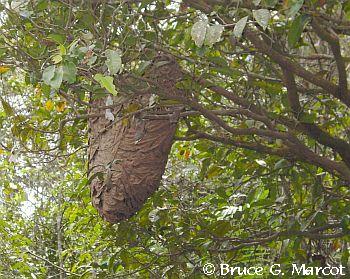
The local people say the wasps are ferocious and follow you for 2 km, stinging. They said that there are only two ways to get rid of the nests: burn them with fuel (often not available) ... or there is an owl here that closes its eyes and eats the wasps. Quizzing one of the local Bantu fellows (Arthur Botay Mputela) more closely, I narrowed down the owl species to Vermiculated (or Bouvier's) Fishing Owl, Scotopelia bouvieri. This was an unexpected story of a beneficial (ecologial and cultural) function of a large owl of the region. Most other owl stories relate them in negative ways. I have not read anything about this (or any other) owl species engaging in such a behavior, but whether the story is apocryphal or actual, it paints the owl in a positive light.
But other attitudes were present as well. In the village of Bongonde Drapeau (between Mbandaka and Bikoro), I asked a local Bantu about owls, and he replied that owls are viewed here as "dreaded." This was essentially repeated by other Bantu people in other villages we visited. However, I was surprised at how willing local villagers were to help me locate owls at night, once I expressed my scientific interest in finding, calling, and seeing them. Apparently, local beliefs did not inhibit at least some of the people in seeking out owls in the forest at night.
I also discussed the cultural view of owls in Cameroon, with George Akwah, one of my travelling hosts and colleagues who is from that country. He said that in Cameroon, witches are reported to transform into owls. Also, owls announce bad news or foretell death. If you make a call like an owl, people will scold you to stop, saying "Are you a witch?" In Cameroon there are also folk tales about bats which people do not distinguish as a mammal and think of as intermediate between a mammal and a bird (in fact, the French word for bat there is "duplicate").
03 November 2006 More owl tales from the Democratic Republic of the Congo (DRC), following another expedition I made there during October 2006 to west central DRC. I traveled to the village of Monkoto and into Salonga National Park (the largest tropical forest park in Africa) and interviewed several groups of people.
Local village chiefs : Within Salonga National Park, I interviewed four Chiefs of local village groups ("groupements"): Chief Lokuli Bosami of Village Groupement Yangi, Chief Bokele Lomama of Village Groupement Isaka, Chief Bokongo Botuli of Village Groupement Mpongo, and Chief Mbeko Ingala of Village Groupement Entoo. The interview was in (my) English translated into (their) Lingala.
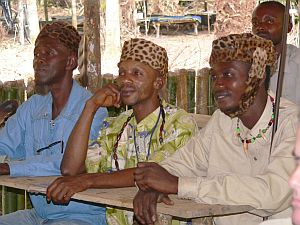
- They noted that the perception of owls is "not good." When you hear an owl, it means bad news, such as "perhaps a relative has died back in Kinshasa" (the capital city of DRC). So owls are feared, as they "bring prophecy."
- Although owls are known to be bad, they are also occasionally eaten (as are most other animals in the region). Both large and small owls are eaten.
- Owls are "bad species" by custom, but only against men, not women.
- There is no formal hunting of owls. Owls are killed when they are seen, though, opportunistically.
I probed as to which owls they know. I showed them pictures from my bird book and also played various owl calls from my tape recorder. Most interestingly, it turned out that the "owls" they fear really are only the males of one species: African Wood Owl, Strix woodfordii , a species that most commonly is found around and within villages and secondary forests. To this end, the chiefs noted that there are "two kinds of cries" of the (wood) owl: the bad cries from the male which mean bad news, and another cry from the female which does not mean bad news. What they referred to as the male's bad cry is the typical multi-note song of the African Wood Owl (which in actuality is given by both sexes), and what they referred to as the female's cry is the single-note wail call (probably most often given by females, but possibly also by males and immatures).
They use the Lingala term esukulu ("es-oo-KOO-loo") to refer to "owl" but this really is a direct reference to the "bad" African Wood Owl. The term refers to both sexes of this species.
They use the Lingala term lokio ("low-KEY-oh") to refer to the Vermiculated Fishing Owl (Scotopelia bouvieri), which they say (accurately) occurs only along the river (in riparian gallery forests, as I had also discovered there), and that calls early morning, such as 3 to 5 a.m. Vermiculated Fishing Owls are not bad omens, as they never enter villages.
They use the Lingala term enkimeli ("en-kim-EL-lee") to refer to Pel's Fishing Owl ( Scotopelia peli ), which also is a riparian or flooded-forest species, is not a bad omen, and does not enter villages.
They also spoke of another small owl that "has no cry," which might refer to a number of other possible small owls in the area that do not have calls like the wood owls or fishing owls (although they do have their own distinct, different vocalizations).
Also, they spoke of another owl-like creature called lyokokoli ("leeyo-ko-KOH-lee"; this is not Lingala but instead a local dialect, as there is no Lingala word for this) which is "very rare" and "appears once every forty to fifty years." It has a long wail call that increases in pitch. It is not an owl. They were unable to identify or describe it any further, and I don't believe than any of the chiefs have personally seen this creature; it may exist in story only.
I asked if there are any positive aspects of owls, such as providing special powers, and they replied no. Also, eating owls does not confer any special powers or traits.
Local women forest gatherers : In the village of Monkoto, I interviewed four women who gather non-timber forest products in the forest on a near-daily basis. The interview was mostly in French and (their) Lingala.
They said that local belief in owls pertain to ndoki ("en-DOH-kee"), which is magic or sorcery. When you hear an owl you think of sorcery. Owls are feared because when one cries by your house it means bad news. Then you must throw stones at it to chase it away.
Owls are bearers of news about the death of a relative elsewhere.
They too knew the term esukulu .
I asked if owls are ever eaten in this village, and they said no.
It appeared that they were referring to African Wood Owls, but it was not as clear that it is only this species that is bad.
19 December 2007 While visiting Serena Mountain Lodge on the slopes of Mount Kenya, I engaged an elder naturalist and local field guide, Vincent G. M. Kiama, in discussions of owl lore. He told me that the local people fear owls that "make noise," especially if the owl lands on the rooftop. This is particularly a bad omen, that someone will be reported having died the next day. The older generations have been told and believe such stories, but not the younger generations, said Vincent; apparently, such story-telling is not being passed along.
1 January 2008 At Lake Baringo in the Rift Valley of western Kenya, I spoke with a naturalist and local bird guide Cliff William Kiror about local owl lore. He relayed stories told by the two local tribes, the Tugen tribe of the Kalenjin people, and the Mjemps tribe of the Masai people. If an owl appears on your house, one story goes, it may signal that someone will die. If an owl appears on your house in the daytime, you may go blind. Cliff noted that the such beliefs were held by the older generations but are now being replaced by more rational and conservation-minded thinking of the younger generation.
But still, Cliff said that when an owl appeared on his own family's house, his two sisters wanted to kill it. Cliff explained to them that owls cannot cause death or blindness and should be spared, and his sisters heeded his words.
Appendix 3
Owl Tales from North America by Bruce G. Marcot - Postscripts to "Owls in Lore and Culture"
1 December 2001 I recently had an opportunity to spend a day hiking the South Rim of the Grand Canyon in Arizona with a wonderful Native American lady, and we discussed owl lore. She comes from two pueblo tribes, the Hopi in Northern Arizona and the Isleta which is south of Albuquerque along the Rio Grande River, New Mexico. She relayed to me some owl stories she was told while growing up. Owls were viewed by these tribes as harbingers of ill health and ill fortune. An owl once came to their house and shortly thereafter her younger brother fell ill. If an owl was heard calling, she and her siblings would go outside and shout at it, trying to compel it to leave.
23 November 2004 I had an interesting discussion on the role of animals, and on owl lore in particular, with Ernie Philip, Elder and Cultural Coordinator of the Shuswap Tribe. We met at the Quaaout Resort & Conference Centre on the shores of the Little Shuswap Lake outside the small town of Chase, British Columbia, Canada (east of Kamloops in south central B.C.). Ernie conveyed to me several owl stories of his people. Mostly, owls are viewed as messengers and usually portend a forthcoming death, but the messages are not always bad. You have to know how to read the messages, how to understand the owl s calls. Ernie told me that, as a youth, he was taught this by his elders. I asked if it is only the larger owls that convey the messages of death and he said no, it is all the owls, including Screech Owl, Great Horned Owl, and the others as well.
Appendix 4
Owl Tales from Tanzania, Africa by Bruce G. Marcot - Postscripts to "Owls in Lore and Culture"
09 October 2012 Told to me by Peter Njau of the Chagga Tribe, east side of Mount Kilimanjaro, Tanzania:
- If an owl comes to your window, it is very bad.
- Women will pour sour milk onto the ground as a libation to ward off the owl.
- Men will sacrifice live animals in sacred places, to ward off the owl.
- If the owl returns, especially three times, people believe that it might be their ancestor. Then they will pour sour milk onto the ground and talk to the ancestors (kind of an appeasement libation), so that the ancestors/owl will not harm them.
Peter Njau said that such beliefs are now fading, and occur only in rural villages.
Other beliefs held by his tribe, as conveyed by Peter:
- If an owl lands on the roof of your hut or house, this is very bad and means death or illness.
- Peter says that his uncle firmly believes that you should not travel if you hear an owl, as that would bring misfortune. In a specific instance when Peter and his uncle were to drive from Dar es Salam to Arusha, an owl spent a night at his house, and his uncle refused to travel the next day, it is "bad news, I am telling you, don't go." They stayed for two days. The owl flew away and came back, several times. There was someone who was very sick for a month, then died, ostensibly attributed to the owl.
14 October 2012 I interviewed Chief Labulu of the village of Tarangari Masai Boma on his tribe's beliefs in owls. (Following is a transcription from an audio-recording I made of the interview.)
- Owls are the birds which bring bad news mostly.
- When the owl comes and sits on the roof, it brings bad news, it is the sign of a bad thing, especially if it also calls. If it sits there for a short time and flies away, it's OK; but not if it lingers.
- If the owl perches on the roof and stays, and calls, how can this problem be solved? They mix red ochre and charcoal, and put it around the house and say, you have brought bad news here, just go away with the bad news, don't leave the bad news here.
- If the owl perches in a nearby tree and calls, that can affect the cows. The cows may start dying. So to ward this off, they put the red ochre and charcoal around the tree and tell the owl to go away with the bad news it has brought here.
- The big owls are the ones that are easy to see, but all owls, including the small ones, bring bad news.
- The Masai general word for owl is ngukuma.
- Will attitudes change if you find out that owls eat rats and other vermin that you don't want? Answer: we have domestic cats for this purpose.
- What do you think of a scientist who studies owls? Answer: It is hard for me to understand; you could study other things, why owls? Things that bring bad news, why do you have to study those things? For this tribe, you may be associated with voodoo.
- If I bring owls in at night by vocalizing their calls, the local people will think I have voodoo.
- Peter Njau added: Then if something goes wrong in the village, you may end up being the first suspect. Even in my (Peter's) tribe (Chagga), you may be the first suspect.
- Does this tribe use owl parts, feathers, talons, for anything, including food? No, they won't even touch the owl.
- But they (shamans) can use owl eggs for witchcraft, to harm somebody. Doesn't know how this is done, specifically, what the egg is mixed with.
- Does each boma have a shaman? It's passed on across generations, and boys are trained. Shamans are in the community.


