The Owl Pages

Great gray owl invasion begins

Article Date: 2005-02-20   Source: http://www.wisinfo.com   Comments: 0

Wisconsin, U.S.A. * - Wisconsin is being invaded by nomads from the north and they're crossing our borders and airspace unchecked in record numbers.

Although it may sound ominous, you really don't have anything to fear from this invasion - unless you happen to be a mouse or vole, that is.

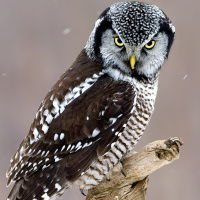
Ever since last October, large numbers of gray owls, along with boreal and northern hawk owls, have made their way into northern Minnesota and Wisconsin. Some have even showed up in the southern and eastern part of our state like the northern hawk owl I saw recently in Ozaukee County.

But the most spectacular show of all has to be the appearance of so many great gray owls, North America's largest owl.

Why have all these foreign owls come here? The answer is "food." Great gray owls show up in Wisconsin almost every winter, but every decade or so there is a huge winter migration of great grays from their boreal evergreen forest homes in Canada, south to the northern states.

Biologists refer to this periodic migration by northern owls as an "irruption" and is caused by a lack of food to eat in their home range.

Great gray owls eat mostly voles, a small mouse-like rodent, during the winter months. Vole populations in the northern forests have their ups and downs in cycles. When their numbers bottom out, like they did this year, the northern owls have no choice but to move south to find food or face starvation.

Great gray owls are impressive-looking birds with their bright yellow piercing eyes, large heads and huge facial disks. Although they have a wing-span of 60 inches across and can stand up to 33 inches tall, they only weigh about two or three pounds, less than the smaller great-horned owl.

Great grays are normally very reclusive and are rarely seen due to their nocturnal habits in the remote forests and maple-hemlock swamps in Canada.

For some reason, they usually hunt during the daylight hours, when they migrate south to more heavily populated areas and don't seem to be bothered by people watching them.

Their lack of fear may be because they just don't see that many people in their wilderness homes or it might be they just have no choice but to hunt in open view.

Most of our voles live in grassy farm fields, woodland edges or along roadside ditches.

Most owls and hawks catch rodents by waiting for them to come to the surface and then pick them off as they scurry along out in the open. Great gray owls take a more aggressive approach to catching their prey Their large flat facial disks are used like megaphones to enhance their already super-sensitive hearing. This allows them to locate mice and voles by sound as the rodents move about in their maze of tunnels under the snow. Once a rodent is located, gray owls drop out of the sky and are able to pounce through two feet or more of hard crusty snow to catch their prey.

The great gray owl is a close relative of our familiar barred owl and also to the rare spotted owl of the western states. All three of these owls are similar in appearance with the prominent facial disks, brownish plumage and their lack of ear tuffs or "horns". The great gray owls is much larger than its cousins, however, and has yellow eyes compared to the dark brown eyes of the barred and spotted owl.

Great gray owls will soon leave the state and return to their home range in the far north to begin nesting and raising their young. They have the reputation of being exceptional parents. If voles are still scarce during the nesting period, they will start themselves in order to have enough food for their chicks to eat. They are also extremely protective parents and have been known to viciously attack anything, including bears, lynx and even people, that get too close to their nesting sites.

Hopefully, the northern vole population will have recovered by next fall and the great gray owls of the northern boreal forests won't have to make another invasion south in search of food. But if not … they'll be back.

Disclaimer: This article has been reproduced from http://www.wisinfo.com and placed here for comment. OwlPages.com is not responsible for the accuracy of any information in this article, and does not necessarily agree with the author's opinions.

Comments


Comment on the above News article.

Your Name (Required)
Where are you from? (Optional)
E-mail Address (Optional)
Comments (Required)
As OwlPages.com is not responsible for this article, we are not able to answer any questions relating to it.


The Owls   dl.id.au


New cache file written