Boxes are helping barn owls
Article Date: 2006-05-09 Source: http://www.theprogress.com
Comments: 0
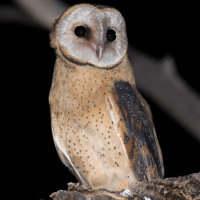
By Jennifer Feinberg Chilliwack, British Columbia, Canada - The biggest threat to the western barn owl is the steep decline in habitat due to rampant urbanization.
That's why the work of one local guy with a penchant for banding raptors seems to be making quite a difference.
The only significant population of barn owls left in Canada is in a pocket from the Lower Fraser Valley up to Hope, including some on Vancouver Island.
Nesting sites in old-growth trees have given way to spots in abandoned or
inactive barns, says barn-owl bander Richard 'Dick' Clegg.
He's a veterinarian who's lived in the Chilliwack area all of his life. Clegg is concerned that most of the old barns are being replaced by metal structures which don't match the barn owl's nesting needs.
Clegg earned a federal banding permit years ago, ''after much waiting and
pleading'' which allows him to band baby barn owls for research purposes. He's
banded 450 barn owls in the past five years, and figures the local barn owl
population could number up to 250.
He clamps a tiny metal band around a bird's leg, which provides data if the bird
one day turns up in a biologist's lab.
''We always knew about barn owls when we were kids. I first got involved in
banding raptors 20 years ago on the Prairies, and it sort of extended into
this,'' explains Clegg.
He was only too happy recently to escort a Progress news team into an inactive
barn site on Prest Road, where one of his home-made nesting boxes contained a
baby owl that was born as a direct result of the habitat work he's done. One
thing the public may not realize is the owl's special symbiotic relationship
with the farmer, Clegg points out.
There's a long history of the owl living, nesting and foraging in harmony with
humans on agricultural properties.
''They can do a lot of good. Barn owls almost exclusively eat small rodents and
starlings, which I think some of the farmers may be interested in hearing,'' he
says. But if there's a safety message for the public on that score, it's about
being exceedingly careful about poisoning rodents around barn owls.
''Rat poison effectively kills off the mice and rats, but then the slow-moving
rodents get eaten by the owls,'' he explains.
This spring he's seeking out potential new sites in older barns where farmers
might let him install a nesting box.
The barn that Clegg is showing us has a decayed, almost medieval look to the
interior. The pair of owls housed in the barn used regurgitated mice pellets to
build a nest in one of his boxes. The egg-sized pellets, made from compacted
rodent bones and fur, are black clumps strewn all over the hay bow.
It was like being within the confines of a dark, decrepit cathedral with holes
punched into the wooden ceiling where streams of sunlight pour through.
Clegg spryly shimmies up and then down a ladder one-handed, with a downy-headed
baby owl in his tight grasp. The owl fledgling had hatched in the nest Clegg
made from recycled timber less than two months ago, and his off-white feathers
are almost grown in.
But when the baby is plucked from the safety of the dark nest by the
dedicated vet, the owl lets loose the loudest, most other-worldly, bone-chilling
shriek imaginable. The noisy baby bird's complaints continued in earnest for the
entire visit, which the raptor expert attributed to the being an ''only child.''
The visiting reporter and photographer could do little more than study the young
owl in jaw-dropping awe for a few moments, repeating the wholly inadequate ''wow''
over and over.
The vet has learned so many interesting factoids about the owls, like how they
hatch sequentially. So one egg may be hatched one day, and another a couple of
days later.
''These birds are pretty reclusive,'' Clegg explains. ''They like quiet and
tolerate no disturbances.''
When he first started his banding work, he'd meet some local farmers who didn't
know him or his work, and they wouldn't tell him the truth about the existence
of owls in their barns.
''Some are quite protective,'' he recounts. ''I'd ask farmers if they had
any barn owls in their barns and they'd say no.''
But now he has about 50 active nesting sites in the Chilliwack and Agassiz areas
where he heads straight for the barn on arrival to check the nest or band young
fledglings.
''The barn owl is not endangered, but a species of special concern, which is one
notch below endangered,'' Clegg offers.
A number of research and nest box projects are underway on the Lower Mainland.
Anyone with a suitable location in a barn for a nesting box, and who would like
to participate, is asked to leave a message for Clegg at 604-792-1501.
Disclaimer: This article has been reproduced from http://www.theprogress.com and placed here for comment.
OwlPages.com is not responsible for the accuracy of any information in this article, and does not necessarily agree with the author's opinions.
Comments
Comment on the above News article.
|