The Owl Pages

Local researcher spots owl's rare breeding area

Article Date: 2006-05-27   Source: http://www.lohud.com   Comments: 1

By Greg Clary

Westchester, Illinois, U.S.A. - James Vellozzi normally deals with mosquitoes and ticks in his Fordham University research in Westchester, but recently something a little bigger caught the attention of the veteran bird-watcher.

''I just happened to look at a tree cavity, and something moved in it,'' he said. ''At first I thought it was a squirrel. I never thought it would be a saw-whet owl.''

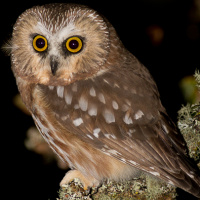
A northern saw-whet owl, or Aegolius acadicus, to be exact.

The discovery surprised Vellozzi because he didn't think the species nested in Westchester or the Lower Hudson Valley.

He was right.

State bird experts say Vellozzi's sighting of a northern saw-whet female raising her five fledglings is the first recorded incidence of the bird setting up housekeeping in Westchester and may be the first such discovery downstate in at least a decade, if not four.

"That's a great sighting," said Jillian Liner, a biologist with Audubon New York, the state chapter of the National Audubon Society. "It's not shocking, but it is unusual. They are hard birds to find because they're very quiet. They don't make a lot of movements. They don't actually flush when approached."

The nocturnal raptors reach about 7 inches in height, with wingspans more than twice that. They eat rodents, mostly field mice and voles, but also will grab flying squirrels and some birds for a meal.

They're the smallest owl species in eastern North America, weighing about the same as an American robin. Most are a rusty-brown color and have a monotone whistle.

Rich Anderson, assistant director of Constitution Marsh Sanctuary in Cold Spring, said his organization recorded a saw-whet breeding area in Putnam in 1995, but a statewide bird survey done between 2000 and 2005 produced no evidence closer than Sullivan and Ulster counties.

A previous, similar survey done between 1980 and 1985 showed none as well.

Other than that, the only other recorded case, bird experts say, was Suffolk County in 1968.

Pat Leonard of the Cornell Lab of Ornithology in Ithaca said one breeding spot doesn't represent a trend, obviously, but the discovery nonetheless is good news.

"One is kind of a lonely number, but it's promising," Leonard said. "It depends a lot on whether the habitat stays protected." Leonard said there about 240 species of birds in New York and about 700 in North America.

Saw-whet owls themselves are not strangers to the area. They routinely come to the southern parts of New York from the more northern regions because the supply of rodents and other sources of food during the winter is better the farther away one gets from deep snow and freezing temperatures.

They usually return to the colder climes when it comes to laying their eggs and, like eagles, often will return to the same spot if it proved successful in prior breeding seasons.

Vellozzi, a 33-year-old Ardsley native, said the baby birds were born in mid-April.

"Once we saw the fledglings, that's all the confirmation we needed that this is a breeding ground," Vellozzi said. "We just kept an eye on the female. There didn't seem to be a male around."

Vellozzi said saw-whet owls are believed to be "opportunistic nesters," content to allow some other animal to do their work for them.

"They'll follow woodpeckers into trees and use the holes that are already there," Vellozzi said, noting the opening he saw was a little bigger than a baseball and about 10 inches deep. "She just laid the eggs on woodchips on the bottom. There was no nest."

A biologist at Fordham's Louis Calder Center Biological Field Station took the babies out one at a time, weighed and put bands on the legs for research purposes.

Vellozzi said officials at the center were pleased to see that the youngest bird was well-fed, meaning that the mother had been bringing enough mice that everyone got hearty meals, not just the biggest and quickest.

With survival rate for these birds about 10 percent, the chances of them all making it to build nests of their own is slim. The young birds make a good meal themselves for other birds of prey and local animals like raccoons, experts said.

For now, Vellozzi will do his best to keep disturbances in the area to a minimum and hopes to send his record of the sighting to the New York State Avian Records Committee within two weeks.

"In the birding community, it's a big thing," Vellozzi said.

Disclaimer: This article has been reproduced from http://www.lohud.com and placed here for comment. OwlPages.com is not responsible for the accuracy of any information in this article, and does not necessarily agree with the author's opinions.

Comments


On 2006-06-12, from White Plains, New York wrote: "Nice find, James. "


Comment on the above News article.

Your Name (Required)
Where are you from? (Optional)
E-mail Address (Optional)
Comments (Required)
As OwlPages.com is not responsible for this article, we are not able to answer any questions relating to it.


The Owls   dl.id.au