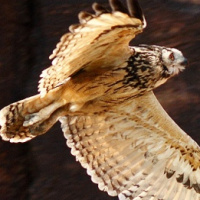
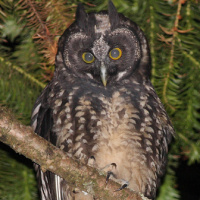
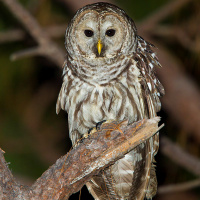
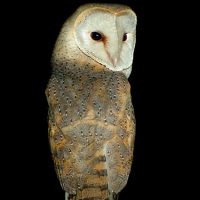
Male owls pitch their hoots to advertise body weight to competitors
Article Date: 2007-04-02 Source: http://www.eurekalert.org
Comments: 0
By Patricia Morse Europe - Why do male owls hoot? Researchers from the Centre d'Études Biologiques de Chizé (France) and the University of Sussex (UK) have studied the vocal communication of male European Scops owls, one of the smallest living species of nocturnal raptors. The study, published in the April issue of the American Naturalist, was conducted between June 2003 and June 2005 on the isle of Oléron, off the west coast of France, where Christian Bavoux and Guy Burneleau have been studying the local scops owl population since 1981.
The authors have analyzed several hundreds of hoots recorded from 17 territorial
males and demonstrated that the pitch of the vocalization reflects the body
weight of the male: the heavier the male, the lower the pitch of his hoots. In
order to see whether this information is actually used by male owls during
territorial interactions, the authors conducted a series of playback experiments
(commonly used in studies of animal communication in order to assess the
function of vocal signals), monitoring the reaction of subjects to the broadcast
of vocalizations. To do this they modified the pitch of several hoots, creating
stimuli that mimicked the hoots given by males from a range of body weights.
They then played back these recordings to males with established territories,
and observed and quantified their response (a combination of approaches and
vocal responses). The results show that male owls respond more strongly to the
high-pitched calls that simulate lighter individuals, confirming that
territorial males attend to pitch information advertising body weight in the
calls of their competitors. The authors also found that the territory owners
give slightly lower pitched hoots in response to calls mimicking heavier males,
probably indicating that they attempted to sound heavier when challenged by more
threatening individuals.
"The fact that owls are essentially active during the night puts a strong
emphasis on acoustic communication as a means of assessment, both during male
competition and during mate choice," says Loďc Hardouin who recently completed a
PhD on acoustic communication and territoriality in owls. "The next step is to
see whether females use these quality cues when they choose their mating
partner." "The vocal communication of owls has interesting similarities to that
of terrestrial mammals where the information is typically encoded in acoustic
components of the calls rather than in the diversity of the vocal repertoire as
it is in songbirds," says Reby, who is an expert in the study of mammal vocal
communication.
Loďc A. Hardouin, David Reby, Christian Bavoux, Guy Burneleau, and Vincent
Bretagnolle, "Communication of male quality in owl hoots" The American
Naturalist, volume 169 (2007), pages 552–562 DOI: 10.1086/512136
Disclaimer: This article has been reproduced from http://www.eurekalert.org and placed here for comment.
OwlPages.com is not responsible for the accuracy of any information in this article, and does not necessarily agree with the author's opinions.
< Previous News article | Next News Article >
Comments
Comment on the above News article.
|