Experts ponder latest menace to the spotted owl
Article Date: 2004-06-01 Source: http://www.katu.com
Comments: 0
Portland, Oregon, U.S.A. - Loggers have long been shut out of the northern spotted owl's habitat, but the owl protected by the Endangered Species Act is still being forced from its nesting places.
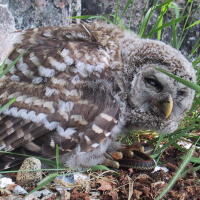
But not by man - by its cousin, the barred owl.
Even with diminished logging, spotted owl numbers are crashing in parts of
Washington where barred owls are numerous. In Oregon, in one region near
Roseburg, almost nine of every 10 spotted owls either moved or disappeared
after a barred owl came calling.
"We go back to where they were and they're just not there anymore," said Eric Forsman of the U.S. Forest Service, one of the top spotted owl
researchers in the Northwest.
An analysis of the spotted owl in coming weeks is expected to outline the
threat in more detail, as part of a review sought by the timber industry.
It will lead to a decision by the Bush administration on whether the
spotted owl remains protected.
There's talk of evicting barred owls in places, to see how spotted owls
do. And the timber industry wants to know: If barred owls occupy spotted
owl trees, can those trees then be cut down?
Even the Audubon Society of Portland, a bird's best friend, is conflicted.
Officials there helped file the original lawsuit that halted logging to
protect the spotted owl. But they have a pair of barred owls nesting on
their land in Portland and, said Susan Ash, acting conservation director,
"They're very cool birds."
Their hooting calls have eight notes to a spotted owl's four, probably why
they are also known as "hoot owls" or "eight hooters." Their wings stretch
more than three feet across. They're not as finicky about food as spotted
owls, gobbling up just about anything they can catch.
Very little bothers them, except for great horned owls, their only real
predator.
Audubon of Portland is trying to figure out where it stands on the idea of
taking out one owl to aid another.
"It's been the source of a lot of tension within the organization," Ash
said. "Any time you talk about killing one species, it's difficult. Now we
happen to be talking about a very charismatic owl species."
"It's sort of a quandary," said Rocky Gutierrez, a professor of wildlife
ecology at the University of Minnesota who has long studied spotted owls.
"What do you do when one species invades the range of another, especially
when the other is on the endangered species list?"
Adding confusion to the picture is the question of whether the barred owls
are moving into the western forests on their own, or if they're following
human development. The birds first appeared in Washington in the 1960s,
Oregon in the 1970s and California in the 1980s. Their numbers have been
taking off since.
"It's hard to know if we should sit back and let nature take its course,
if that's really what's happening, or if we should try to step in in some
way," Ash said.
Forsman, who has watched the spotted owl for decades, suspects the barred
owl acted alone, moving to the Northwest like so many fleeing
Californians.
Gutierrez doesn't buy the single-suspect theory. He thinks the owl had
help. Perhaps by stomping out wildfires on the Great Plains, he said,
people let trees grow up along rivers. They would have become avian
highways west.
"It sure seems peculiar that they waited thousands of years to make this
leap across the continent," he said. "I just don't think it's
coincidental."
There may be at least a few thousand barred owls in the Northwest, and the
number is rising. There may be as many as 8,000 pairs of spotted owls. And
there are some "sparred owls," offspring of interbreeding between the two,
that may further confuse things.
Biologists didn't plan on all this when they mapped out reserves for the
spotted owl and other species that would become the blueprint for public
forest management. But they don't fault the barred owl for taking them by
surprise.
"I wouldn't put it in terms of bad or good," Gutierrez says. "I would put
it as, 'Is it a threat to the spotted owl?' And the answer is yes. I think
this thing is happening more quickly than people expected it would."
Disclaimer: This article has been reproduced from http://www.katu.com and placed here for comment.
OwlPages.com is not responsible for the accuracy of any information in this article, and does not necessarily agree with the author's opinions.
Related Articles:
2009-12-09 - Barred owls could get the boot (or a bullet) to save spotted owls by Matthew Preusch - Portland, Oregon, U.S.A.
2008-06-03 - New Threats to the Spotted Owl Prompt Legal Notice on the Elliott State Forest by Noah Greenwald - Portland, Oregon, U.S.A.
2007-06-12 - Spotted Owl Old Growth Habitat Protections Reduced - Portland, Oregon, U.S.A.
2007-04-28 - U.S. proposes killing owls to save another - Portland, Oregon, U.S.A.
2007-03-16 - Spotted owl ruling halts local logging by Paul Fattig - Portland, Oregon, U.S.A.
2007-02-16 - Appeals court says spotted owl protection violated by William McCall - Portland, Oregon, U.S.A.
2005-04-20 - Old Growth Up, Spotted Owl Numbers Down by Jeff Barnard - Portland, Oregon, U.S.A.
2004-06-22 - New threats imperil spotted owl - Portland, Oregon, U.S.A.
< Previous News article | Next News Article >
Comments
Comment on the above News article.
|