As spotted owl's numbers keep falling, some fear it's doomed
Article Date: 2008-08-13 Source: http://seattletimes.nwsource.com
Comments: 0
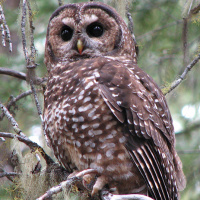
By Warren Cornwall Washington, U.S.A. - The northern spotted owl - an endangered icon that spurred a rescue effort so sweeping it brought old-growth logging to a virtual standstill in the Northwest - is now closer than ever to extinction.
Fourteen years after old-growth logging was banned on most federal lands to
protect the owls, their numbers are falling year after year.
While there is disagreement over how bad it could get, some are contemplating
the virtual disappearance of a bird elevated to sainthood by environmentalists
and hung in effigy by loggers.
The situation is particularly bad in Washington, where the rate at which owls
are found at nesting sites has fallen by nearly half since 1994. Scientists
blame the decline largely on the invasion of a tougher owl and the loss of much
habitat to decades of logging.
"It's not looking very good," said Eric Forsman, of the U.S. Forest Service, a
pre-eminent spotted-owl scientist. "The populations seem to be gradually going
downhill, and it's not clear if or when that's going to stop."
The decline of the birds is forcing a rethinking of long-held strategies to save
the spotted owl. Ideas under consideration include the distasteful prospect of
shotgunning one owl species to save another.
It could also rekindle the old-growth logging debate. Since the bird was a chief
tool for environmentalists to block logging, what happens if there are no
spotted owls left in a forest?
Plan hasn't worked
Back in 1994, few could have foreseen things turning out this way.
The Clinton administration - spurred by lawsuits, the listing of the owl under
the Endangered Species Act, and years of political upheaval over Northwest
logging - set aside 24.5 million acres of federal forestland as a haven for the
owls.
The Northwest Forest Plan was supposed to set the stage for recovery of the
football-sized bird, which favors older forests because it nests in the cavities
of big trees, and eats forest-dwelling creatures such as flying squirrels.
But the recovery hasn't happened.
It's unknown exactly how many spotted owls there are. Scientists take the bird's
pulse by monitoring huge patches of forest from Washington's Cascades to
Northern California.
In every one of those places, there are more empty nests today than in 1994.
Harder to find
Dale Herter has grown accustomed to disappointment.
Every year the wildlife biologist returns to the forests north of Mount Rainier
to track spotted owls. All too often, a nest occupied the year before is silent.
In the 16 years since he first started cruising the woods, hooting like a
spotted owl and listening for a response, Herter has seen the population drop by
half.
"Within a decade we may not have any in Washington unless they do something,"
said Herter, who works for the Seattle environmental consulting firm Raedeke
Associates.
On a recent day, crouched on a steep hillside in the Mount Rainier foothills, he
came eye to eye with one of the last hopes for spotted owls there.
Herter perched a white mouse on a stump. Within seconds, the mouse disappeared
in a hushed blur of talons and brown and white feathers. A female spotted owl
winged between the branches of Douglas firs, clutching her prey.
Herter scrambled to a dirt road, striding along to track the owl.
"I see a baby," announced fellow birder Alan Grenon.
"That's cool, at least one survived," Herter said.
"Oh, there's two," Grenon called out.
These fledglings were two of 10 Herter counted. It's the fewest he's found
during a peak year, when the owls should be most productive.
Genetic "bottleneck"
The magnitude of the problem was confirmed by a new analysis of spotted-owl
genetics.
With little fanfare, federal scientists in July publicly released a study
warning that northern spotted owls, particularly in Washington, have reached a
"population bottleneck."
The remaining birds are genetically similar enough that there's a heightened
risk of inbreeding, the study found. The bottleneck also threatens the genetic
diversity that helps a species adapt to changing circumstances.
It's not clear if this is already a reason owl populations are falling. But the
authors said we could be witnessing a bird in a downward spiral, exacerbated by
a shrinking gene pool, known as an extinction vortex.
"I have not lost hope for spotted owls. But I think we're at a pretty serious
crossroads," said Susan Haig, a wildlife geneticist with the U.S. Geological
Survey and one of the study's authors.
Forsman, however, said it's too soon to predict the owl's fate. There are still
sizable spotted-owl populations, particularly in southern Oregon and Northern
California. Spotted owls might also change their behavior in some way that
enables them to survive.
"There's no way at this point to predict how this will ultimately play out."
Owl competitor
Scott Gremel points the finger at one chief culprit for what he's witnessed in
Olympic National Park: the barred owl.
Bigger, more versatile and able to hatch more offspring, the barred owl could
hardly be better suited to compete with spotted owls.
Gremel, a biologist who has tracked the owls in Olympic National Park since the
1990s, has an unusual vantage point. Clear-cuts haven't threatened owls in the
park's protected forests.
Yet their numbers keep dropping as barred owls move into valley after valley.
Last year, just 37 percent of the places in the park where spotted owls once
nested were still occupied by the birds.
"Someone described it as a bathtub. It's just filling up with barred owls," he
said.
Across the West Coast, the barred owl is a prime suspect in the spotted owl's
disappearance.
Native to the East Coast, it's thought to have reached the West Coast in the
mid-1900s via forests in Canada. But it wasn't until the 1960s and 1970s that it
first was seen in Washington and Oregon, and in the last two decades its numbers
have exploded.
Some researchers caution that it's still not known how much havoc the barred owl
is causing.
Spotted owls are also vulnerable to harsh winters, loss of old-growth habitat to
forest fires, and continued logging. Some of the decline might be an aftereffect
of logging on federal lands in the 1980s.
But a handful of studies and scientists' repeated stories of barred owls
harassing spotted owls all suggest the barred owl is taking a toll.
"If you get a room of field biologists, people who have been out in areas where
barred owls are present in any number, you don't get any disagreement about it,"
Gremel said.
Shooting next?
Desperate government wildlife managers are now considering experiments of
systematically shooting barred owls.
In a preliminary test in Northern California, researchers shot seven barred owls
near former spotted-owl nesting sites. Spotted owls returned to all the sites.
Lowell Diller, a biologist with Green Diamond Resource Co., which owns the
forest where the shootings took place, thinks it's a worthwhile experiment, even
if it's controversial.
"As a society we may choose not to control barred owls. But we ought to do it
with the knowledge of what would it take and is it feasible," he said.
There's a bloody history of killing one animal to help another. Brown-headed
cowbirds are shot to protect songbirds, arctic foxes are killed for the sake of
rare ducks, and some want to shoot sea lions feasting on Columbia River salmon.
But Forsman, of the Forest Service, has his doubts.
"You could shoot barred owls forever, and as soon as you quit they're going to
be right back."
Politics of protection
Despite the fear of barred owls, some warn they are political fodder for those
who want to see more logging.
Environmentalists charge that the Bush administration has tried to water down
the Northwest Forest Plan while talking up the barred-owl threat.
In the latest move, on Tuesday the U.S. Fish and Wildlife Service issued new
maps showing which Northwest forests are vital to the spotted owl's recovery.
The agency cut 1.6 million acres from its previous maps, including 400,000 acres
in Washington and 1 million acres in Oregon.
The reduction in protected acreage has come under fire from environmentalists
and several organizations of scientists, who argue the spotted owl's decline
makes old-growth habitat more important, because it offers the owls more refuge.
"They're pulling the habitat rug out from underneath a declining species," said
Dominick DellaSala, chief scientist for the Oregon-based environmental group,
the National Center for Conservation Science and Policy.
Service spokeswoman Joan Jewett, however, said the changes were driven by a
growing scientific understanding of what the owls really need.
"There really isn't any evidence to suggest that creating more habitat reserves
will alter adult (owl) survivorship," she said.
Ross Mickey, of the American Forest Resource Council, accuses environmentalists
of trying to use the owl's woes to lock up more forests.
"All you're doing is ... protecting more habitat for the barred owl," said
Mickey, whose group represents the timber industry.
If spotted owls vanish from some forests, it could reshape the political
pressures that led to the Northwest Forest Plan.
The plan is meant to help a lot of old-growth species, but the amount of
protected federal land was set with spotted owls in mind. If the birds are gone,
it could be easier to whittle away at those areas, said Chuck Meslow, a retired
federal wildlife biologist who helped craft the 1994 plan.
It's on Washington's state and private lands where the decline of spotted owls
could make the most immediate difference.
There, logging is often allowed in older forests, except in places with
spotted-owl nests. Fewer owls could mean fewer places off-limits to chain saws.
The state Department of Natural Resources in 2005 put a moratorium on lifting
protections for areas around abandoned spotted-owl nests. That was spurred
partly by concerns that barred owls were driving them from prime habitat.
The moratorium is scheduled to expire at the end of the year.
"You can't give up," said DellaSala. "Giving up just opens the floodgates for
more logging."
Disclaimer: This article has been reproduced from http://seattletimes.nwsource.com and placed here for comment.
OwlPages.com is not responsible for the accuracy of any information in this article, and does not necessarily agree with the author's opinions.
Related Articles:
2009-04-02 - Spotted-owl recovery gets another look from Obama administration by Warren Cornwall - Washington, DC, U.S.A.
2008-08-24 - Spotted owl's diminishing numbers have some fearing species is doomed by Warren Cornwall - Seattle, Washington, U.S.A.
2008-05-22 - Baby owls get new home after accidental trip from Ellensburg by Steve Powell - Washington, U.S.A.
2007-09-29 - Protection plan for owls not worth a hoot? by Les Blumenthal - Washington, U.S.A.
2007-04-26 - Environmentalists say feds trying to weaken spotted-owl forest plan by Warren Cornwall - Seattle, Washington, U.S.A.
2005-08-09 - Spotted owl is on a dangerous decline by Robert McClure - Washington, U.S.A.
2004-09-25 - Report: Spotted owl still declining in the Northwest by Matthew Daly - Washington, U.S.A.
< Previous News article | Next News Article >
Comments
Comment on the above News article.
|