
About Owls
Most Owls are active at dusk and dawn, spending the daytime at a quiet, inconspicuous roost. They can be found roosting singly or in pairs or family groups, but may form flocks outside of the breeding season (A group of Owls is called a parliament).
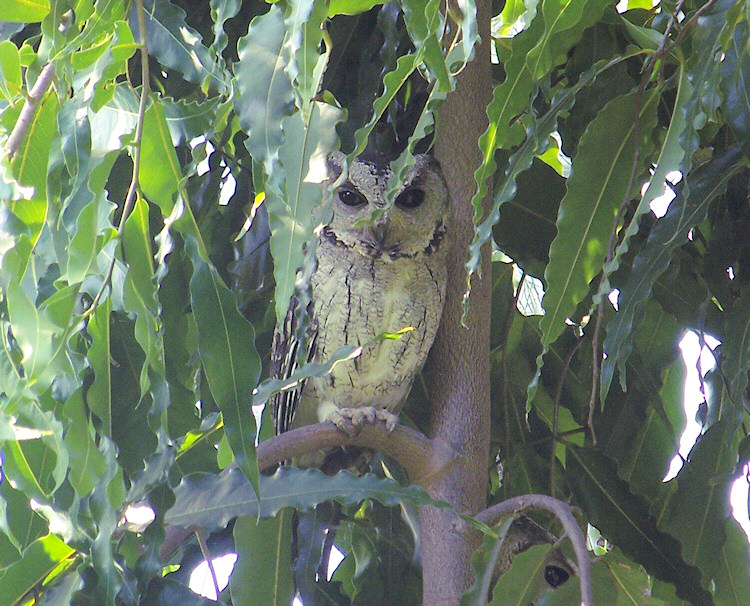
An Owl's daily activity begins with preening, stretching, yawning and combing its head with its claws. The plumage is often ruffled up, and claws and toes are cleaned by nibbling with the beak. The Owl will then leave its roost, sometimes giving a call (especially in breeding season).
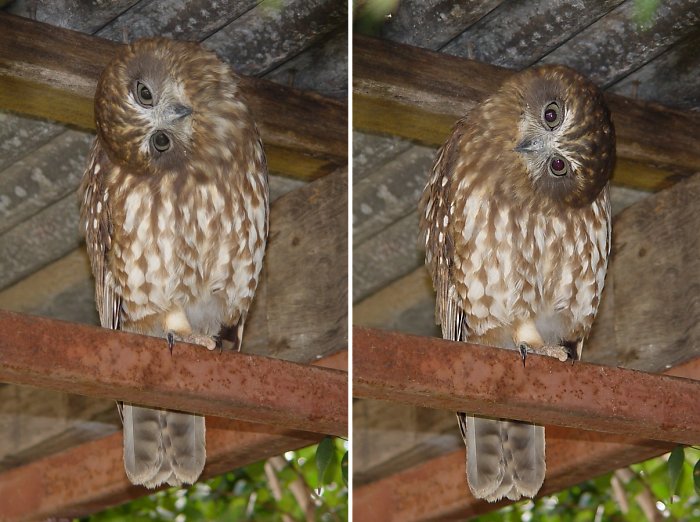
Owls have a very expressive body language. Many species will bob and weave their head, as if curious about something - this is in fact to further improve their three-dimensional concept of what they are viewing.
When relaxed, the plumage is loose and fluffy. If an owl becomes alarmed, it will become slim, its feathers pulled in tightly to the body, and ear-tufts, if any, will stand straight up. A pygmy Owl will cock its tail and flick it from side to side when excited or alarmed. Little owls bob their body up and down when alert.
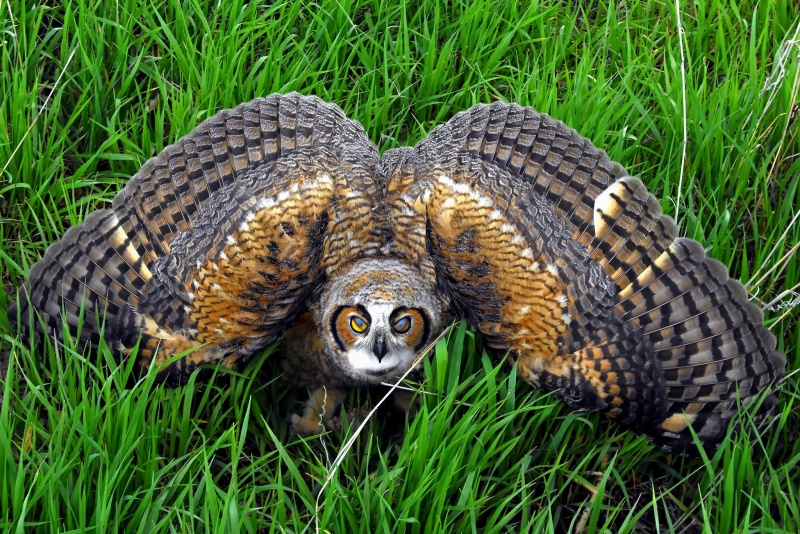
When protecting young or defending itself, an Owl may assume a "threat" or defensive posture, with feathers ruffled to increase apparent size. The head may be lowered, and wings spread out and pointing down. Some species become quite aggressive when nesting, and have been known to attack humans.
Owls will bathe in shallow water, and also in rain.
Calls: Owls have a very wide range of vocalisations,
ranging from the hoots so often associated with Owls, to whistles, screeches, screams,
purrs, snorts, chitters and hisses. Hooting is often territorial, and is also associated
with courting, the male usually having the lower pitched Hoot. It should be noted that not
all owl species Hoot.
Owls can also make clicking noises with their tongues, often as part of a threat display.
They may also clap their wings in flight as part of a mating display.


Mobbing: Because Owls are predators, they are feared by
many birds. For this reason, they are often attacked or harassed by groups of smaller
birds. This is not limited to one species, as once the attack begins, many different birds
will join in.
Interestingly, the Owl rarely responds to the harassment, and it is just as rare for the
Owl to be injured in any way! The mobbing may succeed in forcing the Owl to move on to a
different area. The retreating Owl is often pursued by the mob.
Migration: Owls are generally resident birds. Some Northern populations of certain species may escape harsh winters by moving south.


