Owl Feathers & Flight
By Deane Lewis
Feather types
Birds have up to five feather types:
1. Contour feathers cover the body, wing (remiges) and tail (rectrices).
2. Down feathers - these soft and fluffy feathers trap air and create a layer of insulation next to the bird's body.
3. Semiplumes function to fill in between contour and down feathers.
4. Bristles are small feathers with a stiff shaft and barbs only on the base, or often not at all.
Bristles occur most commonly around the base of the bill, around the eyes, and as eyelashes.
5. Filoplumes are hairlike feathers that consist of a very fine shaft with a few short barbs at the end. They are typically covered by other
feathers, and may function as pressure and vibration receptors - they sense the location of other feathers so they can be adjusted properly.
An Owl has very few down feathers, but has downy barbules on the parts of the contour feathers closest to the skin.
Many of the Owl's feathers are specially designed - around the face there are the stiff facial disc feathers or ruff, crown feathers,
ear-flap feathers and also bristles around the bill. The feet and bill have Filoplumes that work somewhat like feelers, to help the Owl react to things they touch, such as prey.
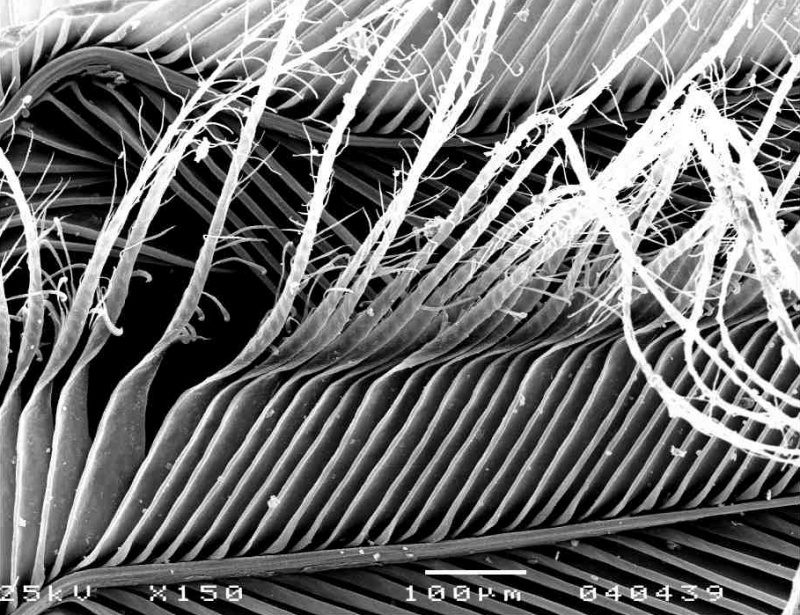
Feather of an African Eagle Owl magnified by 150 times under a scanning electron microscope. Image ©
Paolo Taranto
The most unique adaptation of Owl feathers is the comb-like or fimbriate (fringe-like) leading edge of the primary wing feathers referred
to as "flutings" or "fimbriae". With a normal bird in
flight, air rushes over the surface of the wing, creating turbulence, which makes a gushing noise. With an Owl's wing, the comb-like feather
edge breaks down the turbulence into little groups called micro-turbulences. This effectively muffles the sound of the air rushing over the wing
surface and allows the Owl to fly silently. There is also an alternative theory that the flutings actually shift the sound energy created by the wingbeats
to a higher frequency spectrum, where most creatures (including prey and humans) cannot hear.
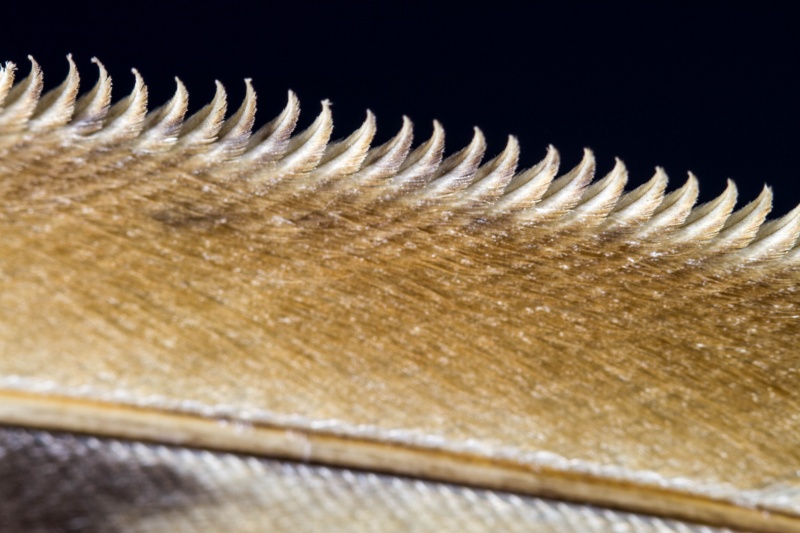
Comb-like leading edge of Barn Owl flight feather. Photo ©
Kay Schultz
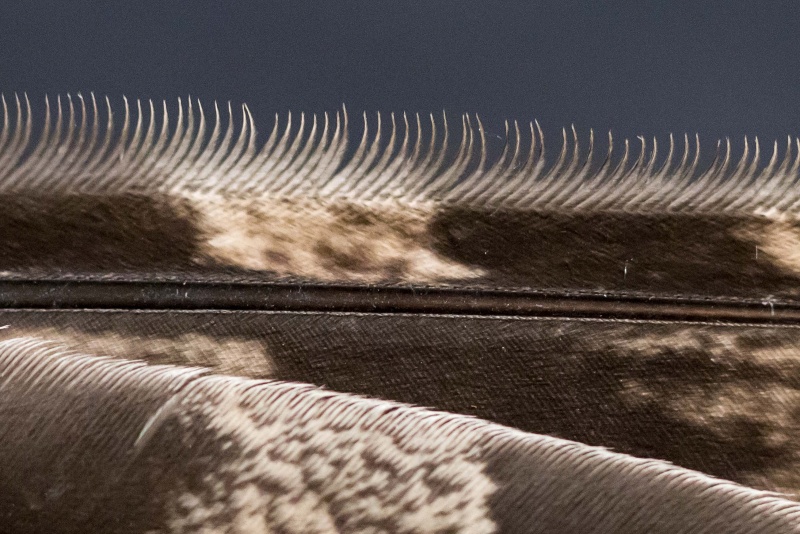
Comb-like leading edge of Great Horned Owl flight feather. Photo ©
Kay Schultz
Silent flight gives Owls the ability to capture prey by stealth, and also
allows the Owl to use its hearing to locate potential prey. This adaptation is not present on some Owl species that hunt in the daytime.
Pattern and Colour
In general, an Owl's cryptic colours and pattern allow it to blend in with its surroundings, hiding it
from potential danger. This is especially important for the nocturnal owls, as they need to remain hidden when roosting in the daytime.
When threatened, an owl will often take up a concealing posture, with closed eyes, raised ear tufts, and compacted feathers.
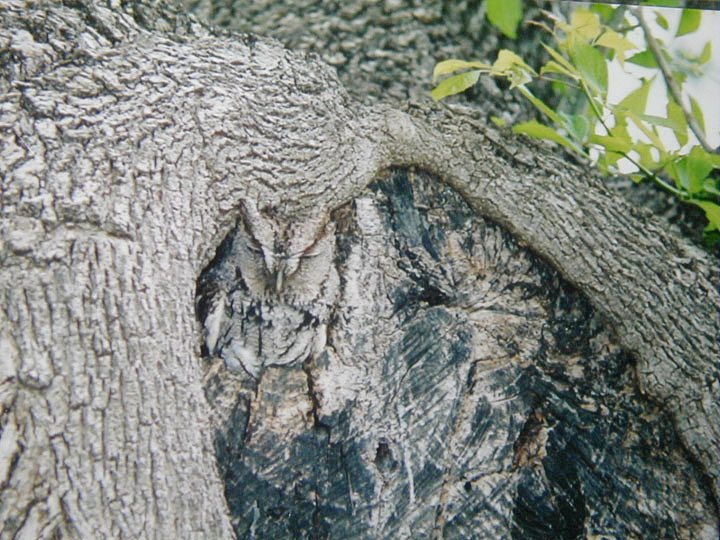
An Eastern Screech Owl blending in with its surroundings. Photo ©
George Aldredge
It is also interesting to note that although owls of the same species look alike, each individual owl within a species has slightly different markings.
Many of the Pygmy Owls have "false eyes" on the back of the head. This is known as an occipital face, and can confuse potential predators.
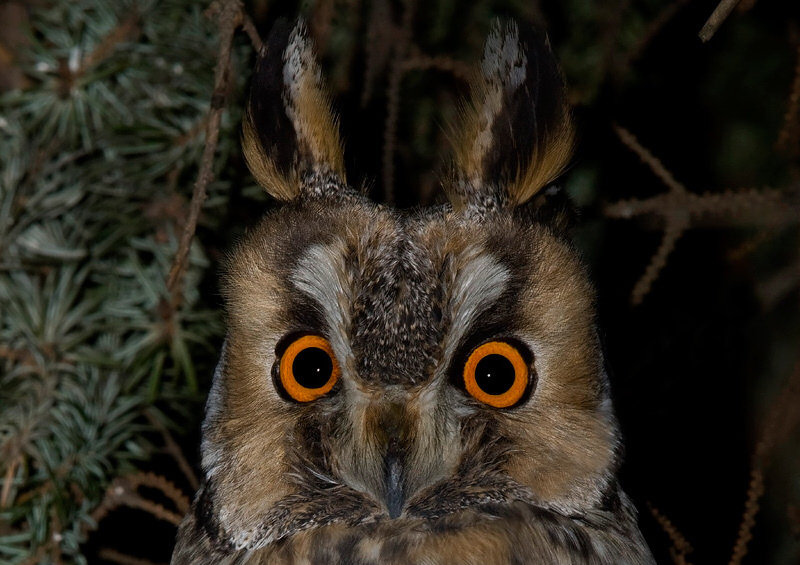
Ear-tufts
Also known as plumicorns, the ear-tufts are actually nothing to do with hearing, they are display feathers, used to indicate moods, such as fear, anger and excitement. They
also help with camouflage. Not all species have ear-tufts. While not having true ear-tufts, many of the Pygmy Owls are able to extend the feathers above
the eyes in an outwards direction, resembling small ear-tufts. This is usually done in response to a predator or when the bird is alarmed.
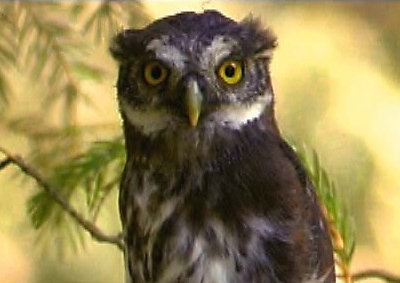
Pygmy Owl showing extended brow feathers. ©
Claus König
Preening
All birds frequently clean and groom their feathers in order to remove dust, dirt and parasites. Owls,
like most other birds, use their beak and talons to do this. The two outer talons on the owls feet are the "feather combs". The sharp
medial edge of these outer talons enables them to clean their heads.
Flight feather barbs have tiny barbules that lock the barbs together,
making the feather into a single continuous surface. These barbules often
become unhooked during harsh flying conditions or collisions. A bird will
use its beak to realign the unhooked barbs and restore the feather to peak condition.
There is small gland called the uropygial, located at the base of
the tail, that produces a thin oily liquid. This gland is stimulated by the beak, which is then used to transfer the liquid to the feathers to
provide them with a protective coating.
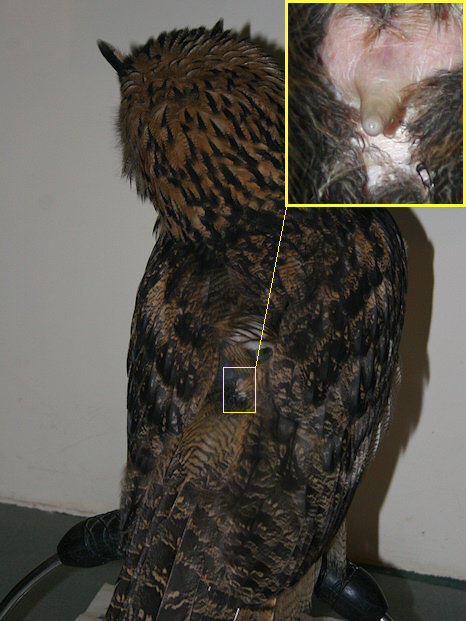
Eurasian Eagle Owl showing the location of the Uropygial gland. Photo ©
Ian Berwick
Molting
When an Owl hatches, it has no flight feathers, but is covered with downy feathers that keep it warm.
This down is gradually replaced with feathers as the Owl grows. Juvenile plumage is similar to adult's, but often paler, and sometimes with
different markings.
An adult bird's colour is derived from mature feathers. During the normal course of the bird's life,
these feathers suffer from damage caused by abrasion, flexing and even collisions.
Like other birds, Owls regularly replace their feathers in a process known as molting. This usually happens once a year,
beginning after the parent birds have raised a brood that has fledged and can care for themselves.
The process takes up to 3 months, during which feathers are shed and re-grown over the
entire body in a regular pattern. In order to minimise the impact of the molt on the Owl's flight and hunting skills, this molting pattern only
allows a few of the primary or secondary flight feathers to be shed at time.
With the exception of the Barn Owl, molting of wing feathers is from the inside out. Barn Owl wing feathers are replaced from the middle of the
wing out (in both directions). Tail feathers also drop out a few at a time, except in some smaller Owl species, who loose all the tail feathers at once.
When birds molt, new feathers grow to replace the ones that have fallen out. The new feathers immerge
from the skin tightly bound in a thin shaft of tissue. These are called pin feathers.
The shaft splits shortly after, allowing the new feather to unfurl and grow to its full size.
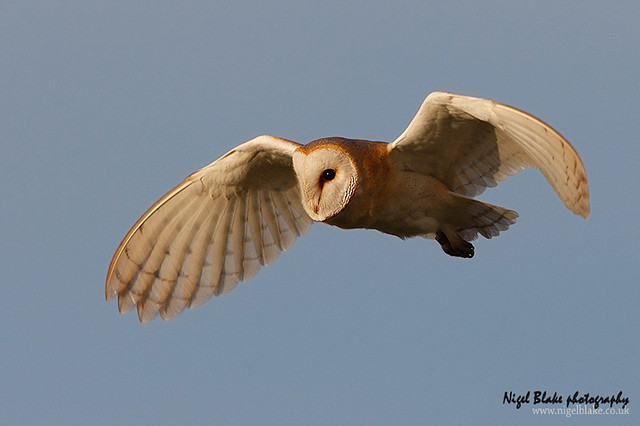
Flight
Most owls have relatively large, rounded wings. The wings are broad, with a large surface area relative to the weight of
the bird i.e. a low wing loading. This allows them to fly buoyantly and effortlessly, without too much flapping and loss of energy.
They can glide easily and fly slowly for long periods of time. Many species use this slow flight to hunt
ground-dwelling prey from the air.
References: (may contain affiliate links)
Anderson, George W.. 1973. "An Experimental Investigation of a High Lift Device on the Owl Wing". Air Force Institute of Technology Air University.
Campbell, Wayne. 1994. "Know Your Owls". Axia Wildlife.
Holt, D. W., R. Kline, and L. Sullivan-Holt. 1990. "A description of 'tufts' and concealing posture in Northern Pygmy-Owls". J. Raptor Res. 24:59-63.
Page updated 2015-10-14